
We Are in the Shorthorn Business: Two New Additions
Not long after Junior Nationals, I was minding my own business when I saw on Snapchat that the Cates were taking sale photos. Immediately, my brain went ‘oh no’ and ‘oh yes’ at the exact same time.
You see, those sale photos meant that one of the best years of my life — a year that started when we bought Bill Jr. on Labor Day 2025 — had come to an end. Ironically, if you’d checked in with me this time last year, I would have told you the exact same thing. Buying Margie on Labor Day 2024 had started us on what felt like the best year ever.
And now, somehow, we’ve had two of them in a row.
How lucky am I?
Of course, I knew it was coming. In the same way I know Christmas is coming soon and I better get serious. We had our plane tickets and hotel rooms. Months earlier, Dad had received what felt like a kismet invitation to judge a Supreme Heifer Drive at the Kentucky State Fair, which I quickly registered as an opportunity for him to go look at the sale heifers, too. I knew where we were headed.
THE SEARCH FOR THE NEXT ONE
Yet the nerves don’t ever go away. How heavy it feels to say out loud what I’ve realized only in the last couple of months: we are searching for what we believe is the best Shorthorn heifer in the USA.
I will always hope she’s in Modoc.
However, I owe it to myself and our operation to do my due diligence and make sure she is.
The last two years, I never really questioned it. We went to Modoc to find our next heifer, and we did. But a lot has changed. I know the pedigrees better. I know more breeders. And maybe most importantly, we believe in ourselves a little more. Our world got bigger. So did the responsibility I felt to look.
After the incredible summer Knox had, heifers were finding us, too. My dad put it plainly in a text he sent me the morning of the CF sale: “If there’s a good heifer, you’ll likely see her before most people do.”
So I did my homework. I turned over almost every rock I could. I prayed for wisdom. Yes, about a cow purchase. And by Saturday morning of the sale, I once again believed the best Shorthorn heifer in the USA was in Modoc.
That gave me clarity, confidence and peace.
LABOR DAY SHORTHORN WEEKEND IN INDIANA
Friday morning we arrived in Modoc. I was armed with an entire iPhone note shared between Luke, Dad and me.
Dad had been there a week earlier and made his pass through every heifer at CF. His notes from seeing them in person were mixed in with ours from the videos, and he had picked favorites within the different age groups. But he had one overall favorite.
Beside lot 10B, a March 1 heifer: “Dad’s pick at CF. Fault free.” As soon as Dad got service leaving Modoc, he had called me. “I looked at all of ’em. She’s the best heifer here.” He never wavered from that.
“I looked at all of ’em. She’s the best heifer here.” – Jim Williams

CF Crystal Lucy 651 “Kevin” — Lot 10B
There it was. The definitive I had been searching for. I couldn’t wait to see her. But I was still going to look at every one of them myself.
By 10 AM, I was standing in a pen down by the sale ring in the unseasonably broiling sun, waiting for Tyler to bring out the first heifers. The younger sale heifers — mostly Aprils and Mays — are housed at the sale facility down the hill. The older heifers, including 10B, were up in the big show barn on the hill.
“Margie was down here,” I said without thinking. I still remember rounding the corner and seeing her from afar standing in what appeared to be the most beautiful grassy pen, beckoning me to come try to pet her — and probably, in my head, have it set to an emotional musical soundtrack.
“No she wasn’t,” Tyler said.
Buddy, don’t question my Margie memory.
Then he corrected himself. “Oh yes, I remember she was. It’s just that she was bigger and heavier than most of the others down here.”
Soon a beautiful group of little fluffy babies joined us, and immediately, it was go time.
Crap! All I want to do is talk to the fluffy roan ones and pet them! But alas, there is work to be done.
Here are the things you can’t really see on videos: feet, base width and thickness, size relative to the others, bone, and mouths and jaws. Dad had already checked those things. Some of his notes were detailed. Others were wonderfully simple.
Lot 19B: “Best April. Sleeper.” (Turns out, she was our third pick.)
Now it was my turn to see if I agreed.
The Aprils were among the first heifers Tyler brought out. Marches and Aprils show together in division, so I knew every April would eventually have to answer one question: Would I rather have Knox leading her, or 10B?
A gentle one is always going to be dangerous for me. Two years ago, I could say it was because we had a first-time showman. But who am I kidding? It’s me. I want them to be sweet. Naturally, one of the fluffy roan Aprils was an absolute pet. I spent half the weekend with my arm around her telling her sadly, “I wish I was going to be your family, but I’m not.”
Dad’s 19B was solid red. She wasn’t nearly as interested in being my friend. But she was good.
The Mays were a different equation. They have their own division, and there were only two May heifers in the sale. Dad had a favorite there, too: lot 16B. In my iPhone note, my highly sophisticated description of her was “Spotty Roan.” Dad’s note from seeing her in person said, “Better than picture.” But I remembered what he’d actually told me on the phone the week before: “I like this heifer. I mean, I don’t know if you want to buy a May, but I like this heifer a lot.”
She was fluffy and roan, so naturally I hoped she would let me pet her. She did not. But I liked her, and I could tell Luke did too. And that was scary as heck!
I did not want to buy a May. They’re the youngest heifers in the sale, and with that comes risk. A lot can change between Labor Day and, say, Cattlemen’s Congress. Time can improve some things. Time will never improve other things. Can you win Junior Nationals with a May? Sure you can. I did with LF Roan Princess in 1999, under THE Harlan Ritchie and his associate, Tim Loudon. But buying a May still means gambling a little, and I’m a Nervous Nelly. More of a minimum-bet-on-the-slot-machine kind of person. I’m still willing to play the slots, though.
I liked ol’ Spotty Roan enough to put a green checkmark beside her. She was the only heifer from that entire group of younger heifers to get one. Then we turned and started up the hill toward the older heifers, and I was still thinking about her. Was I really willing to hang our hopes and dreams on a May?
Probably not.
[Alexa, play “Running Up That Hill” by Kate Bush.]
Up by the show barn, Luke and I shared a few conspiratorial whispers about the younger heifers. “I’ve been updating the note as we see them!” I told him with annoyance. “I can’t look at the note while looking at the heifers!” he said with equal exasperation. Nerves.
The older heifers came out two at a time. I reminded myself to keep my poker face, which is subpar. Naturally, 10B was toward the end. Finally, there she was. Dad’s pick.
She wasn’t fluffy. At all. She was skinny, actually. She was solid red. Darn it. I did NOT want another red heifer. I had loved her picture, but truthfully, her video had been a little meh. None of that mattered much standing there looking at her in real life.
Because I could see her. I could see her as a big heifer on the green shavings at Louisville. She reminded me of those amazing Sullivan heifers that used to whomp on us in the 2000s, back when we were all fighting for our lives in the Shorthorn breed the first time. If you were around for that era, you know exactly what I’m talking about. Tips hat to John Sullivan, always and forever.
Dad was right. She was fault free. More importantly, she made me dream.
Green check.
By the time we’d seen them all, something felt very different from the year before. Last year, I was completely overwhelmed. Three purebred heifers sold for more than $100,000 and another for $75,000 before Bill Jr. ever came in the ring. I liked several of them, and I was paralyzed by the thought that our budget might determine what we bought. We’re normal people. We don’t have an oil well. These cattle have to make money.
Guess what? We got Bill, and she wasn’t our first choice. Worked out OK. As Dad likes to say when something turns out especially well, “Pretty good for sharecroppers.”
This year was different. We had looked at every heifer, and exactly two green checks remained: one from the younger group and one from the older. The older one was the same heifer Dad had picked as the best at CF.
Later that evening, I saw 10B a few different times standing at the hay bale eating. No crowd forming around her. No one stopping to study her. Exciting? Nah. She looked like a pretty forgettable red heifer.
That was more than fine. I hoped most people wouldn’t notice her. I was counting on it.
When Luke and I finally reunited in the car and could talk freely, he agreed. We had our two: 10B and 16B.
Problem was, we didn’t need two heifers. We would have to choose.

The night before the sale in Modoc — one last look at the Shorthorn cattle before the decisions, bidding and surprises of sale day.

Jim Williams in the pens at Modoc. Even with bad knees, he walked the offering because we wanted his eye on the cattle before sale day.
A TOUGH DECISION TO MAKE
As we anxiously waited for the sale order, we sat in the hotel room watching videos, studying the catalog and talking it all through.
“10B has the most video views. What are we going to do if she’s the first heifer in the sale order?” Luke asked.
“Surely she isn’t. I don’t think she’s even on most people’s radar.”
“I don’t see how she couldn’t be.”
“Because she isn’t a fluffy roan, duh!”
I’d been texting with Dad, too. “Y’all always had me several heifers to show, all mid-priced, rarely a real expensive one. And we did very good for 10 years,” I reminded him.
“Yes, that’s good sound thinking.”
The more we talked, the clearer it became: 10B was non-negotiable, budget pending. Dad, Luke and I all agreed. If we could afford her, we were buying her.
The decision was 16B.
She was the opposite kind of temptation. 10B felt steady and safe; 16B was all flash and glitz wrapped up in a little spotty roan heifer. We’d never had one like her. Knox had never led one like her. But she was still a May. Still a gamble. She felt like one of those blackjack hands where the book says you should absolutely double down. (Yes, I used to be a Vegas person. Now I’m a Shorthorn person again. Apparently, I just found a more expensive casino.)
The thought of someone formidable buying her and whomping on us all year was terrifying. Would we spend all year wishing we’d bought her? Or would she disappear and never be heard from again? What could she do for us?
So I started thinking about the dream scenario. What if 10B sold low enough that we still had some money to work with, and 16B sold economically enough that we didn’t have to choose at all?
When the sale order finally came out, I couldn’t believe my eyes.
Apparently, we had picked sleepers.
They were both way down in the sale order, and in exactly the order we would have chosen. 10B would be the sixth or seventh heifer to sell. Then 16B was just two lots behind her. Based on historical sale data, there was a good chance both could be bought for less than we had paid for Margie or Bill Jr.
A plan was taking shape.
Maybe we get two.
SALE DAY
There was one more wrinkle with 10B. She sold as a choice with her full sister, 10A. Luke and I had explained to Knox that if we lost the first bid, don’t panic. We figured most people would choose 10A, which would reopen the bidding on the heifer we actually wanted.
I knew because I’d lived it before. In 2001, we lost a choice lot at WHR, the winning bidder chose the heifer we didn’t want, and the bidding reopened. We bought the second pick — WHR Cumberland 9R86. Cumby went on to win Junior Nationals and the junior show at Louisville, and the other sister never beat her during her show career. After Cumby retired, though, that sister went on to be National Champion in Denver as a cow-calf pair. Everybody got a happy ending.
Twenty-five years later, Luke and I were explaining essentially the same possibility to Knox. And then it happened exactly that way. We lost the first bid. They chose 10A. The bidding opened again, and this time we got 10B — for less.
There was one lot between 10B and 16B, which gave us a minute to catch our breath. Dad was watching online and immediately texted me: “Great buy!!!! Good bidding! Great! Doesn’t break the bank.”
I texted back, “We are going to try to get this next one too. Up to $25K.”
“You got the best one. Go slow. Don’t bid quick.”
We did. When we got to $25,000, I told Knox, “That’s it. No more.” Honestly, I was fine. It would’ve been a good story if we got two. Oh well. Then I looked at Luke. He had a wild look in his eye.
Left entirely to my own devices, I would probably spend a zillion dollars on Shorthorn cattle and live in my car. Luke is generally the one who keeps me in check. Except apparently not today.
Knox does the bidding on his own heifers. Luke looked at him and said, “Let’s hit her again.”
Well then. No complaints from me. Knox hit her again. We went a little over $25,000, and we got 16B, too.

WHR Cumberland 9R86 “Cumby” — 25 years earlier, V8 lost the first bid on a choice lot, then bought the sister they wanted when bidding reopened. Cumby went on to win Junior Nationals and Louisville.
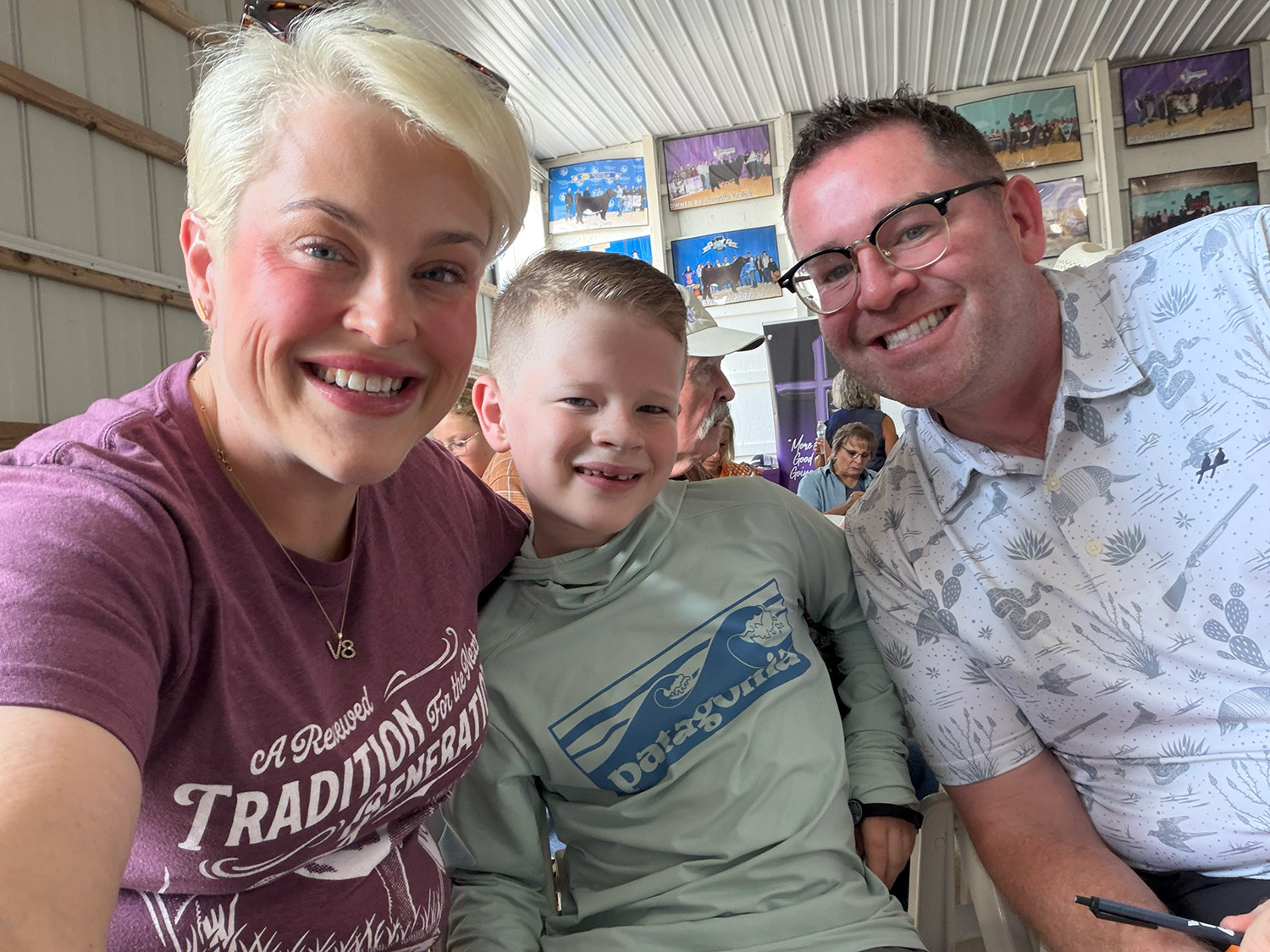
Catherine, Luke and Knox Neumayr in the sale ring at Cates Farms — one sale, two new heifers, and another step toward building their Shorthorn herd.
Dad told me later that as the bidding got painfully slow past $25,000, he thought, “I bet that’s Catherine.”
He was right.
Remember the gentle April heifer I had spent half the weekend with my arm around, telling her I wished I could be her family? She ended up being the high seller at more than $100,000, purchased by people who will no doubt be very competitive with her. And I was relieved. There is a big difference between watching a heifer you desperately wanted sell beyond your budget and watching one bring a pile of money after you’ve already decided she isn’t the one for you. Dad, Luke and I had landed elsewhere. Even better, once they bought her, they weren’t bidding against us.
It worked out beautifully. We went a little over our budget, but not much. We came home with two heifers for close to what we had paid for one in each of the previous two years.
Could one we left behind beat us like a drum somewhere down the road? Of course. That’s showing. People will be busting theirs to beat ours, and we’ll be busting ours, too. We picked the ones we wanted, and we got them. Ideal scenario.
After the gavel slammed, it was easy to flash forward and picture Knox in his maroon sweater vest showing them. I certainly did. We came to Modoc looking for show heifers, and that’s exactly what we bought. But a few hours later, as Luke and I sat at the Modoc Diner waiting on burgers and fries, my mind had already moved beyond the show ring.
I started going layer by layer through our new heifers’ pedigrees, mapping out their cow families. I had studied them enough before we bid to know what we were buying. But now they were ours, and I wanted to know everything. This cow led to that cow. This branch went back here. Wait — look where this one goes.
Suddenly, I was dreaming about something beyond purple banners on green shavings. There were two builders sitting across the table from each other, talking about new building plans. And we’d gotten some good ones.
We’re going to show them, yes. But we’re going to build with them.

Luke with CF Crystal Lucy 651 “Kevin” just moments after the purchase — one of the two green-check heifers the family came to Modoc hoping to buy.
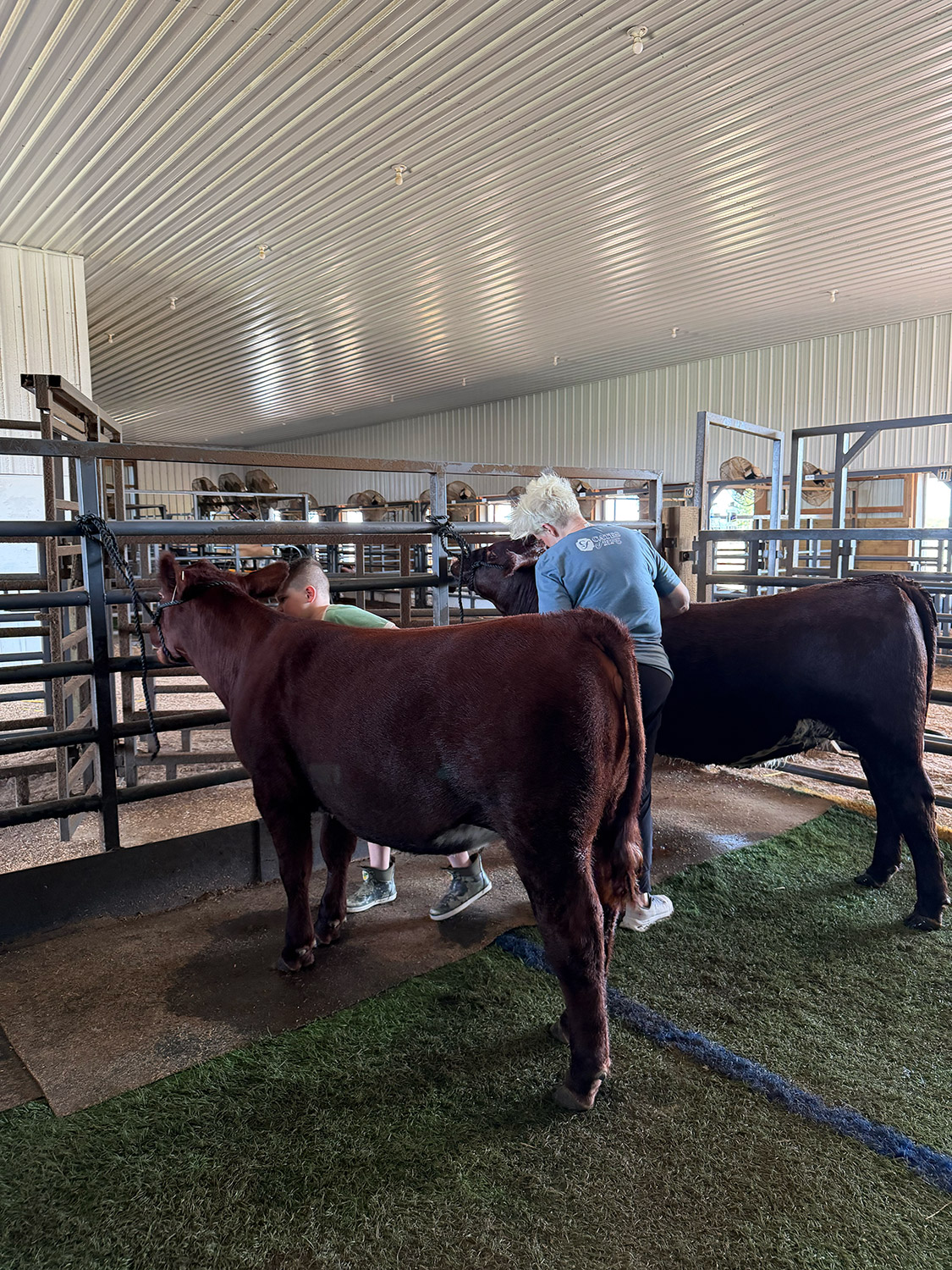
Knox getting acquainted with Kevin after the sale, with CF Myrtle Bo 5127 “Turtle” in the background — the new purchase meeting part of the herd she will help build.

CF Dream Lady 691 “Chiquita” in Modoc — the little May heifer whose potential made us willing to take on more risk.
THE NEWEST V8 SHORTHORN FEMALES
So let me introduce you to heifers number four and five in the V8 Shorthorn herd, and show you exactly what we’re building with them. Fair warning: Get ready for a whole lot of pedigree talk. This may be boring as heck to some people. I could do this all day.
Lot 10B is CF Crystal Lucy 651. Lot 16B is CF Dream Lady 691. And if you know Shorthorn pedigrees, those names may have already told you something.
Crystal Lucy. Dream Lady.
Start pulling on either thread long enough, and you arrive at the same place: AF Shannon Margie 924. The more I study modern Shorthorn pedigrees, the more I find myself back there. All roads — or at least an awful lot of them — seem to lead back to Margie.
CF Crystal Lucy 651 “Kevin” — Lot 10B
The red March heifer who became our must-have at Modoc — and the first of two new Shorthorn females we brought home from the Cates Farms sale.
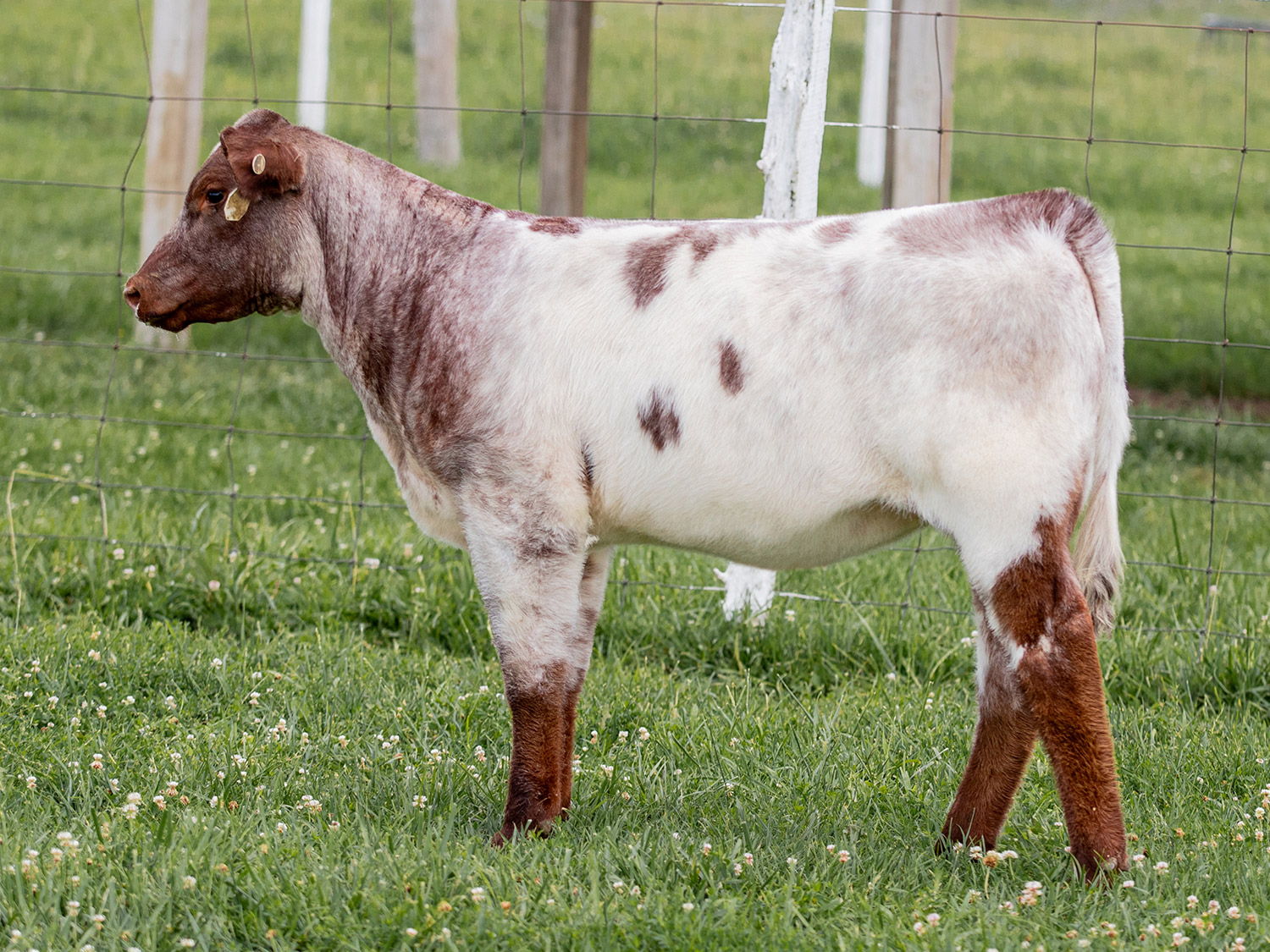
CF Dream Lady 691 “Chiquita” — Lot 16B
CF CRYSTAL LUCY 651 “KEVIN”
So let’s start with 651. Knox continued his tradition of selecting crazy names for his heifers. Kevin was selected based on Kevin the Mad Scientist, who he loves. And, in case anyone is wondering, Knox has informed us that Kevin is British. “All Shorthorns are British,” I told him. “Yes, but Kevin has a British accent. ’Ello, Kev!” — Knox
Crystal Lucys are actually Margies. But I hesitate to say it that simply, because I don’t want to diminish what generations of breeders have done to make the Crystal Lucy branch special in its own right. There are a lot of breeding decisions between AF Shannon Margie 924 and the Crystal Lucys of today.
Kevin is sired by SULL Red Knight 2030 ET, who I never got to see in real life. I’ve Googled him plenty now, though, and there is a photo of John Sullivan holding this incredibly long-bodied bull in the ring at Denver that is firmly imprinted in my mind. Red Knight appears to have won everything but the kitchen sink. We’ve wanted one for a while.
Once I started digging into his pedigree, though, I realized Red Knight is rooted in genetics I know very well. At V8, we trace cow families through the bottom side, so I would call him a HR Mona Lisa W684Y — the same cow family as Bill Jr. And through his sire, CF Solution, he goes back to another cow family I know well: Ka’Ba Rose T90. Solution’s dam, NPS Desert Rose 004, caused us plenty of trepidation when Tyler Hahn showed her at Junior Nationals. But in my opinion, as a producer, Desert Rose went on to beat every one of her contemporaries.
So this elusive Red Knight figure I’d heard so much lore about suddenly didn’t feel very elusive. I may not have known Red Knight himself, but I dang sure know what’s behind him.
Now go to Kevin’s bottom side. Her dam is SULL Crystal’s Lucy ET — the Crystal Lucy, a red-neck roan who won the 2012 Shorthorn Junior Nationals for Nick Sullivan while I was away from the breed. Her sire, Little Cedar Aviator 503X, is from the Rose T90 cow family, too. Follow Crystal Lucy’s maternal line backward and we’re headed somewhere very familiar:
AF Shannon Margie 924 → AF Margie’s Dream Lady ET → AF In My Dreams 487 ET → AF Margies Dream Lady 05 → SULL Lady Crystal 434P-1 → SULL Crystal’s Lucy ET
There it is. The Dreams branched from Margie, and eventually the Crystals branched from them. Each became notable in its own right, but they share the same foundation. Our original CF PC Margie 476, by contrast, is just a plain ol’ Margie. No Dreams. No Crystals. Just Margie after Margie after Margie, all the way back to 924. (I like that too.)
So Kevin gives us Margie through Crystal Lucy on the bottom, Mona Lisa W684Y through Red Knight on the top, with Rose T90 tucked into both sides. Green checkmark indeed.
But here’s what else I see in Kevin’s pedigree: people. John Sullivan, breeder of both her parents. The Cates family throughout. The Kimmerlings — and how appropriate is it that Kevin Kimmerling is in Kevin’s story? — the Hahns, the Studers through Pretender, the Frenches with Aviator and the Rasors with WHR Sonny, a full brother to my Cumby. Mark Ebeling’s belief in Red Rider’s Drive. Ric Hoyt with HR Mona Lisa W684Y. Follow Margie far enough, and the Aldens in Hamilton, Missouri. There are plenty more people and prefixes I haven’t mentioned by name, but that’s what I see when I study a pedigree like Kevin’s: not just generations of cattle, but generations of breeders.

SULL Red Knight 2030 ET — Shorthorn Sire Behind Kevin
SULL Red Knight 2030 ET with John Sullivan — Kevin’s sire, bringing the HR Mona Lisa W684Y and Rose T90 cow families into her pedigree.

NPS Desert Rose 004 — The Rose T90 Pathway

Ka’Ba Rose T90 — A Cow Family V8 Keeps Finding

SULL Crystal’s Lucy ET — Kevin’s Champion Dam
SULL Crystal’s Lucy ET — Kevin’s dam and the 2012 Shorthorn Junior National Champion for Nick Sullivan, tracing through the Crystal Lucy branch back to AF Shannon Margie 924.

AF Shannon Margie 924 — The Foundation Behind the Pedigrees

CF PC Margie 476 “Margie” — Where V8’s Return Began
CF DREAM LADY 691 DTR X ET “CHIQUITA”
The little May got a name upgrade from “Spotty Roan,” and Knox selected Chiquita. If you’re wondering why, her dam is the famous Red Banana ET cow. So we’re going with the banana theme. As much as I love Kevin’s pedigree, I’m equally starstruck over Chiquita’s.
Chiquita’s sire, WSC Dreams to Reality 19K, was news to me. I looked at Luke in Modoc and asked, “Who is Dreams to Reality?” The catalog footnotes offered no intel, so I wrongfully figured he was some nondescript bull the Cates had bred to Red Banana. That made no sense. Red Banana is, in my opinion, one of their two best cows right now, along with SULL Mona Lisa Reward ET, Bill Jr.’s dam. Why would they be flushing her to something nondescript?
Well, they weren’t. Just because Catherine “I Lived Under a Rock” Neumayr missed an era of Shorthorns doesn’t mean the bull isn’t famous. Dreams to Reality was a Louisville Champion! Why was that not in the footnote? Better yet, he’s Margie on both sides. His dam is a full sister to the dam of our CF PC Margie 476 — the “plain ol’ Margie” variety. His sire traces to AF Margie’s Dream Lady 05, the same cow we just found in Kevin’s Crystal Lucy branch. All roads DO lead to Margie.
Now look at Chiquita’s dam, Red Banana ET. Her name gives you absolutely no cow-family assistance whatsoever. The horror! But her sire is SULL Red Knight 2030 ET. See???? We just did this! On the bottom, Red Banana goes back to AF Margie’s Dream Lady 05. So she’s Margie through the Dream branch, blended with Mona Lisa W684Y through Red Knight, with a little Rose T90 tucked in there, too.
Red Banana is famous now. Half interest in her sold in the Cates sale this year for $110,000. Her first Shorthorn calf, a natural calf, was CF In Demand ET, probably the most famous Shorthorn show bull of the last several years. According to the registry, Red Banana has only had four Shorthorn calves so far. She’s just getting started, and I am beyond proud and excited to have CF Dream Lady 691 — with that prefix and that appropriate cow-family name — in our herd.

WSC Dreams to Reality 19K — Chiquita’s Champion Sire
WSC Dreams to Reality 19K — Chiquita’s Louisville Champion sire, with the influential Margie cow family appearing on both sides of his pedigree.

Red Banana ET — The Dam Behind Chiquita
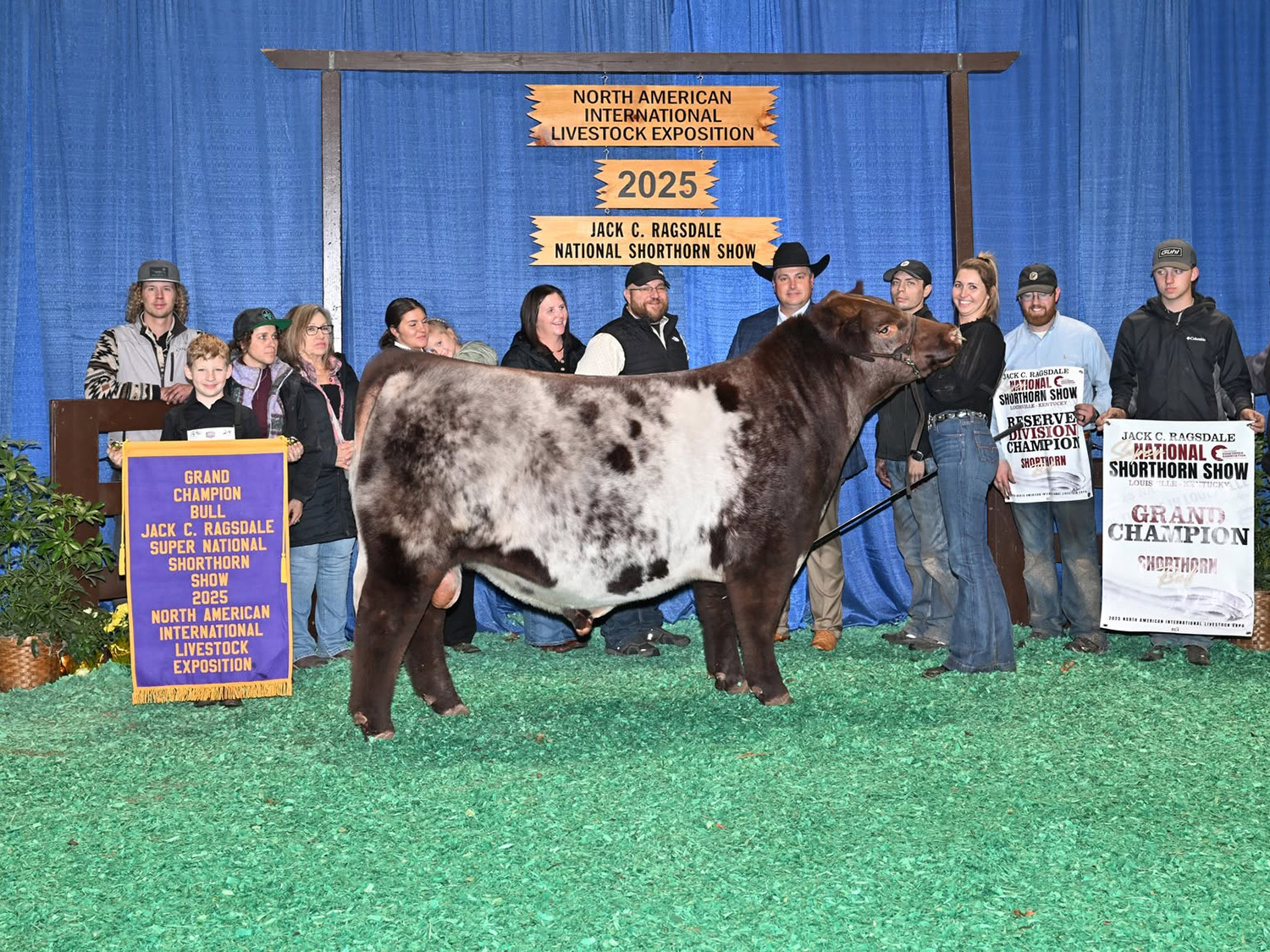
CF In Demand ET — Red Banana’s First Shorthorn Calf
WHAT’S IN A NAME?
Speaking of names, I love Red Banana, although I do wish her registered name kept her cow family represented. Then again, I can’t exactly throw stones. With every one of our heifers except Margie, Knox has replaced a perfectly informative registered name with something crazy.
Dad made a good point, though. We need to make sure we’re calling these heifers by their registered names, too, because those names tell a story. Their cow families are something to be proud of. So, just for the record:
Heifer – Cow family | Sire’s cow family
CF PC Margie 476 “Margie”
Cow Family: Margie
Sired by: CSF Evolution (COW FAMILY: CASINO 100)
CF Mona Lisa 547 “Bill Jr.”
Cow Family: HR Mona Lisa W684Y
Sired by: TRN Omaha (COW FAMILY: MARGIE)
CF Myrtle Bo 5127 “Turtle”
Cow Family: Myrtle Bo
Sired by: SULL Current Commodity (COW FAMILY: ROSE T90)
CF Crystal Lucy 651 “Kevin”
Cow Family: Margie — Crystal Lucy
Sired by: SULL Red Knight (COW FAMILY: HR MONA LISA W684Y)
CF Dream Lady 691 “Chiquita”
Cow Family: Margie — Dream
Sired by: WSC Dreams to Reality (COW FAMILY: MARGIE )
STACK THOSE COWS
Make no mistake, we are buying these heifers to show. We are selecting them for what we believe they can become in the show ring, and we want to win with them. But V8 Shorthorns 1.0 taught us that the show ring and the cow herd don’t have to be separate goals. Most of our great show heifers became the genetics people came to V8 looking for. Their show-ring résumés marketed them for us, but what they did as cows gave those wins staying power.
And when it comes to building from them, this is how I was taught to breed cattle. I’ve heard people my entire life talk about linebreeding to great bulls. At V8, the lesson drilled into me was different: stack those cows. Find the great cows in a pedigree. Find another route back to them. Then another. If there’s a female whose influence you believe in, don’t be afraid to see her name more than once. It’s so ingrained in me that I don’t really know another way to build.
But all this pedigree talk comes after the first test. We pick cattle with our eyes. Dad calls it “the eye of the master.” We are buying these heifers first because we believe in their phenotype and what they can become. Then we study what’s behind them and figure out how to build with it.
Margie taught us that the eye keeps learning, too. She has impeccable feet and soundness. But at Fort Worth, judge Dave Allan studied her, walked around behind her and grimaced. I knew exactly what he didn’t see back there. Margie needed more muscle. More oomph. Dave saw something I already knew was there — or wasn’t there, in this case — and made sure I saw it, too. From then on, we made sure the next ones brought more. Bill Jr. did. Turtle did, with that long body and all that junk in the trunk. I’ll always appreciate that grimace from someone whose eye I respect so much. It moved us forward.
We’re not trying to make five versions of the same cow. We’re assembling cow families we believe in with different phenotypic strengths. Eventually, we’ll get to put those pieces together ourselves, studying what each female gives us and what she needs. Some of those ideas will work. Some undoubtedly won’t. That’s cattle breeding.
We’re two and a half years into building this Shorthorn herd, and I keep coming back to what I know deep down has been the cornerstone of every success we’ve ever had at V8: The Magic is in the Cows. Find the females we believe in, learn what each one brings to the table, and build from them. We don’t know exactly what this herd will look like ten or twenty years from now. But we know how we’re going to try to get there.
And maybe that’s the other thing we’re learning: you can decide to build a cow herd, but you don’t build one alone.
The night Bill Jr. won Junior Nationals, we were at dinner celebrating when Mom announced, “We need Red Knight semen. He was the sire of a lot of good cattle today.” Of course she goes there. I told her I knew we did, but Red Knight semen was hard to find and expensive. Soon thereafter, it was in our tank. Mom wanted the semen, she FOUND the semen, and she bought the semen. That is who she is. Thank goodness she’s on our team.
We already know where that Red Knight semen is going. We’re going to flush Bill Jr. to him and stack HR Mona Lisa W684Y even more. Period. Whatever it is, I’ll look at it and smile and say, “That’s Mom.”
So there’s Mom, the rare semen procurer. Then there’s Dad, who walked every pen in Modoc on knees that had no business doing it because I needed his eyes on those cattle. Scott Dykes, my fake brother, drove him there and listened to cattle notes all the way home. There are others investing alongside us, working with these heifers and sharing what they know.
Luke, Knox and I are building this herd, but we’re certainly not building it by ourselves.

CF Mona Lisa 547 “Bill Jr.” — National Show Female of the Year
CF Mona Lisa 547 “Bill Jr.” — the 2025–2026 National Show Female of the Year, blending two cow families central to V8’s rebuilding program: Margie and Mona Lisa.

CF Myrtle Bo 5127 “Turtle” — Bringing Myrtle Bo Back to V8
WE ARE IN THE SHORTHORN BUSINESS
After the sale, we stayed in Modoc a couple extra days to work with our new heifers and the ones already there. One evening we were at Kyle and Lauren Shoufler’s house while Knox and Hudson played, and Kyle brought over a box of old Cates sale catalogs that had belonged to his grandparents. “Here, I think you’ll enjoy these.”
Boy, did I.
I sat there turning pages through decades of Shorthorn history — and quite a bit of V8 history, too. In Kyle’s grandfather’s handwriting, I found the sale where V8 bought Myrtle Bo 93, the $24,000 high seller who would go on to be National Champion and Junior National Champion for us. Then I kept finding V8. Mature cow for $5,100. Another for $11,000. Another for $6,500. Dad had been buying cows. Good cows. Lots of them.
Then I turned a page in one old CF sale catalog and discovered that apparently Dad had gone embryo crazy. Seven embryo lots. I took a picture of the page and texted it to him, something along the lines of, “And here you think I’m going Shorthorn crazy. Look at YOU back in the day.”
No response.
A couple days later, I was talking to Dad on the phone and reminded him that he had conveniently ignored my evidence. “You never responded to me about buying all those cows and embryos.”
“Yeah, but that was when we were in the Shorthorn business.”
Well.
We are in the Shorthorn business.
Maybe my parents aren’t anymore in quite the same way. But Luke, Knox and I are. And sitting there with those old catalogs spread around me, buying two heifers in one sale suddenly didn’t feel quite so indulgent. It felt familiar. Dad wasn’t buying all those mature cows and embryos because he needed more cattle. He was building.
So are we.
We’re not trying to recreate the V8 Shorthorn herd Dad built. We couldn’t if we wanted to. Some of those families are gone. Others survived, branched and became even more important in the hands of breeders who carried them forward while we were away. Those are the families we’re finding again — not because they’re old, but because they’re still good.
On a ranch with 80 years behind it, we’ve learned not to confuse looking backward with going backward. We study the past because it tells us what lasted. You learn from the people who built before you, pay attention to what endured, and then make the next set of decisions yourself.
Dad had his turn. Now we have ours.
And we will build with these.

CF Myrtle Bo 93 — the $24,000 high-selling Cates female V8 purchased decades ago who went on to become National and Junior National Champion.

An old Cates sale catalog records seven embryo purchases by V8 — evidence of how Jim Williams was building a Shorthorn herd one breeding decision at a time.
WHAT’S AHEAD
And now we get to find out what comes next. We’ll ease into the big leagues this fall — Keystone first, then Kansas City, and finally Louisville. Our new heifers don’t have to do the heavy lifting for us. Bill Jr. and Turtle are both exceptional, and they’ll be there too. But this time last year, we had no idea the ride Bill was about to take us on. We were simply excited about a new heifer and anxious to see what she might become.
This year feels different. We’re going into fall with one heifer we all believe in without question, and another we hope makes us look like very smart risk takers. Of course, they could both make fools out of us. It wouldn’t be the first time. That’s cattle showing.
But oh, how exciting it is to start the possibility again.
STAY UP TO DATE WITH V8 SHORTHORNS
Get ranch updates, sale news, and stories from behind the gates – straight to your inbox.



0 Comments