


From Brahman Cattle Ranch to Big Caribou Country: What Alaska Taught Us
You might think a couple of boys who spend their days working with Brahman cattle on a Texas ranch would be content staying put. After all, we’ve got everything we need right here: thousands of acres of pasture, purebred Brahman that represent some of the finest genetics in the world, and weather that perfectly suits our herd with their legendary heat tolerance. But Alaska? Alaska has a hold on us that’s hard to explain.
TRAVEL DAY NORTH
For the past two summers, Knox and I have made the journey north to Kavik River Camp in Alaska. What began as a curiosity about a TV show has turned into a family tradition, a ritual of sorts. Each August, before the school year begins, we trade in the Texas heat for the wide-open silence of Alaska’s North Slope.
This year, though, was different. Catherine agreed to come along. For two years, Knox and I had been telling her about Sue Aikens, about Kavik, about the way Knox lights up in that wild place. Now she was going to see it for herself.
Leaving the ranch for Alaska is never simple. Just like managing our Brahman bulls and Brahman females requires careful planning, our Alaska adventure demanded meticulous preparation. Bags get stacked like Tetris blocks, gear is triple-checked, and Catherine runs through her list of bug sprays, nets, and creature comforts. Goose, our French bulldog, didn’t want to be left behind — he climbed into an empty suitcase as if to say, “Don’t forget me.”

Explorer in Training
Long before we ever boarded the plane, Knox was in full Kavik mode, grinning under his mosquito net like a true Arctic adventurer.

Sneaking Into the Suitcase
Goose wasn’t about to let the family head north without him — our Frenchie tried to stow away in the luggage.
Knox, on the other hand, was already in full Kavik mode. He strutted around the house in his mosquito face net, grinning ear to ear, already imagining the clouds of bugs he’d conquer up north. It was a sight: Texas boy turned Arctic explorer, before we’d even boarded the plane.
From Houston to Seattle, Knox was laser-focused on one thing: the Alaska Airlines lounge pancake printer. For him, no trip officially begins until he pushes the button and watches those pancakes roll out, steaming and golden, like a magic trick on a conveyor belt. He insisted Catherine see it, beaming as if he’d invented the thing.


By the time we landed in Fairbanks, it was three in the morning, though outside it looked like midday — the endless daylight of Alaska summer. Knox perked right up, leading Catherine through the tiny six-gate airport like a seasoned local. He pointed out the gift shop, dragged us to baggage claim, and posed her in front of the airport’s giant mounted polar bear — just as we’d done with him on his very first trip.
Finally, we made it to Pike’s Landing — our home base whenever we come through Fairbanks. It’s the kind of place that feels both historic and familiar: s’mores kits by the firepits, river views, and the friendliest staff you could ever meet. By now, checking in at Pike’s feels less like arriving at a hotel and more like returning to an old friend’s house.
We had just enough energy to fall into bed, knowing the next morning would mark our real first day in Alaska.
DAY 1 – FAIRBANKS FOG & SILVER LININGS
The alarm clock went off too soon, and we rolled out of bed groggy but eager. This was supposed to be the day we flew north to Kavik — the day Catherine would finally see the place Knox and I had been raving about for years. The anticipation was high: Catherine stepping into the world we’d come to love, all of us reuniting with Sue, and me returning to what has become our family’s favorite place on earth.
Since that first trip, Sue has become more than a friend. She’s family. The kind you want to sit around the table with, swap stories with, and just be near because life feels bigger and lighter in her company. Knox and I couldn’t wait for Catherine to feel that same pull.
But Alaska had other plans. Over breakfast at Pike’s, the call came: fog had blanketed Kavik overnight. With a two-hour flight north, no one knew what the skies would look like when we arrived. That’s the dance of bush flying in Alaska. Sue is a master at it — reading cloud cover, light angles, the way wind shifts through the tundra. Me? Not so much. I just kept refreshing the webcam and relaying what little I knew, while Knox bounced between bites of bacon and questions about when we’d see Sue.
Our departure slipped from early morning to mid-morning, then to afternoon, until finally the pilot called it: “I wouldn’t send my family out in this.”

At first, it was a gut punch. All of that eagerness, bottled up for months, fizzled out in one phone call. But the truth is, these pauses are part of the rhythm of Alaska. Out here, weather writes the script. And sometimes that means surrendering to the delay, finding adventure right where you are.
Knox was quick to make the best of it. He pulled Catherine through every corner of Pike’s Waterfront Lodge — the Aurora Discovery Theater with its film on the northern lights, the library stacked floor to ceiling with Alaskan books, the duck hotel out back, even the secret billiards speakeasy tucked behind a crooked door. To him, Pike’s isn’t just a hotel. It’s a playground, a museum, a base camp for everything that makes Fairbanks feel like home to us.


So instead of flying north, we explored Fairbanks. First stop was Barnes & Noble to stock up on books for a flight that wasn’t happening. Then we drifted through Frontier Outfitters, where mounts of caribou and bears loomed overhead, a reminder that in Alaska, the wild isn’t decoration — it’s life. Lunch was smoked salmon salad for me, macaroni and cheese for Knox at the Blue Roof Bistro. Afterwards, we sat by the Chena River, watching boats slide past in the afternoon light. Knox played with reindeer at the Ranger Station nearby, laughing at their soft noses and awkward antlers. Catherine relaxed for the first time since leaving Texas, a smile tugging at the corners of her mouth.
By evening, we landed at Knox’s all-time favorite restaurant: The Pump House. For him, it’s not a trip to Alaska without it. This time, thanks to a well-connected Uber driver, we ended up with more Alaskan king crab than we could eat — the kind of feast that makes you wish for a second stomach.

Feast at The Pump House
A well-connected Uber driver led us to a table overflowing with Alaskan king crab — more than we could eat in one sitting.

Firepit Evenings
The day ended around the fire at Pike’s — Catherine, Knox, and a stack of marshmallows under Alaska’s never-ending summer light.
The day closed at Pike’s fire pits, roasting s’mores under a sun that never truly sets. Knox prefers his marshmallows charred into “Anakin-in-the-lava” levels of burnt. I like mine golden brown. Catherine watched us, half laughing, half shaking her head at the sugar and smoke.
It wasn’t Kavik River Camp yet. But it was Alaska. And it was ours, together.
Sometimes the adventure doesn’t wait for perfect conditions. Sometimes it starts right where you are — delayed flights and all. Day 1 reminded us that seizing the moment is its own reward. In Alaska, even the waiting feels like a story worth telling.
DAY 2 – NORTHBOUND BOYS
We woke early, bleary but buzzing, and returned to our favorite breakfast spot at Pike’s. Halfway through our coffee came the text from Everts Air: “Cleared for launch.” Kavik was a go.
Flying in Alaska isn’t like commercial air travel back home. It’s closer to calling an Uber — except the “car” has wings, the fare is thousands of dollars, and the driver doubles as your weatherman. Sue had already been in touch with the charter office, relaying conditions from camp. The weather had lifted, visibility was good, and it was time.

Bags Tagged for the Arctic
Every journey north begins with the essentials — carefully packed, tagged, and waiting for a bush plane ride into Alaska’s remote wilderness.

Low Ceilings, High Adventure
For Catherine, even a few minutes inside the cramped bush plane cabin — with its low ceiling, rattling floorboards, and smell of jet fuel — was enough to know this wasn’t her ride north.
This was the day — or so we thought — we’d finally fly to Kavik. Catherine climbed aboard with us. Just walking onto the tarmac was enough to make her pulse quicken. She had seen photos of these planes — the rugged workhorses that ferry people, groceries, and sometimes caribou carcasses north — but photos don’t capture the cramped cabins, the smell of jet fuel, or the moment you realize you’re leaving the last thread of civilization behind.
At first, I thought she might ride it out. But as soon as the hatch closed, panic rose in her chest. Within minutes, she was in tears, whispering, “I can’t do this.” I crawled forward and told our pilot, Gordon, that we had to stop. Catherine stepped off, Gordon calm and kind as he helped her down.
Knox tried convincing her to stay — even calling her a wimp in his eight-year-old bluntness — but she was resolute. Kavik wasn’t happening for her. Not this year. She headed back to Pike’s, where we knew she’d be safe and maybe even relieved.
Sue texted almost immediately, having seen the blip on her flight tracker: “Looks like you turned around. Everything okay?” Only Sue could juggle aviation chatter, weather reports, and paperwork from the middle of nowhere, all while keeping tabs on us from 200 miles away.
And so it was just the boys. As the engines roared and the plane climbed north, Knox pressed his face to the window. The sadness of leaving Catherine behind slowly gave way to anticipation. This was our place, and we were almost home.
Once airborne, the view unfolded like chapters in a story Knox already knew by heart. First Fairbanks shrinking beneath us, then the Yukon River winding like a silver braid, then the jagged blue shadows of the Brooks Range. Finally, as we cleared the last ridge, the world flattened into tundra — endless, treeless, rolling all the way to the Beaufort Sea.
When Gordon banked hard to line up with Kavik’s gravel runway, the plane tilted so sharply it felt like the Gravitron ride from the county fair. Knox whooped. I gripped the seat. Together we laughed with relief that Catherine had, wisely, skipped this thrill ride.

Two hours after takeoff, the gravel runway at Kavik appeared like a pencil line across the vastness. Gordon dropped us down smooth, and engines still humming, Knox was already unbuckled, Nerf pistol in his belt, Hawaiian Bigfoot shirt billowing like a flag of victory. Sue was waiting, arms crossed, grin wide.
Kavik. We were back.
We hauled our bags to the room — the same sturdy cubby where past guests like Sarah Palin’s family had once stayed. Metal walls, three bunks, a desk. Spartan, but safe.
Soon after landing, we pitched in with camp chores. Knox made fast work of tearing down the mountain of cardboard boxes from our supply haul, feeding them into the burn barrel. He turned the task into play — claiming one giant box for himself, hiding inside, and springing out with Nerf shots like a jack-in-the-box outlaw. Kavik doesn’t need playgrounds; it creates its own.


With Sue’s camp chores still keeping her busy, she waved us off with a casual, “Take the bear spray, grab a gun if you want it, and go have fun.” Only in Kavik is that the equivalent of “Go play outside.”
Knox and I headed to the river, where the rain-swollen currents from the day before had cut off many of our usual spots. What was once a playground of smooth rocks and side channels was now icy torrents too swift to cross.
Knox, undeterred, began ferrying willows and stones into the shallows, engineering bridges like a one-man construction crew. I helped where I could, but he was the fearless one, charging through knee-deep glacial water, soaked and shivering but grinning ear to ear. What left me numb with cold was, for him, just another game. It was one of those rare roles reversed — the child leading, the parent following.
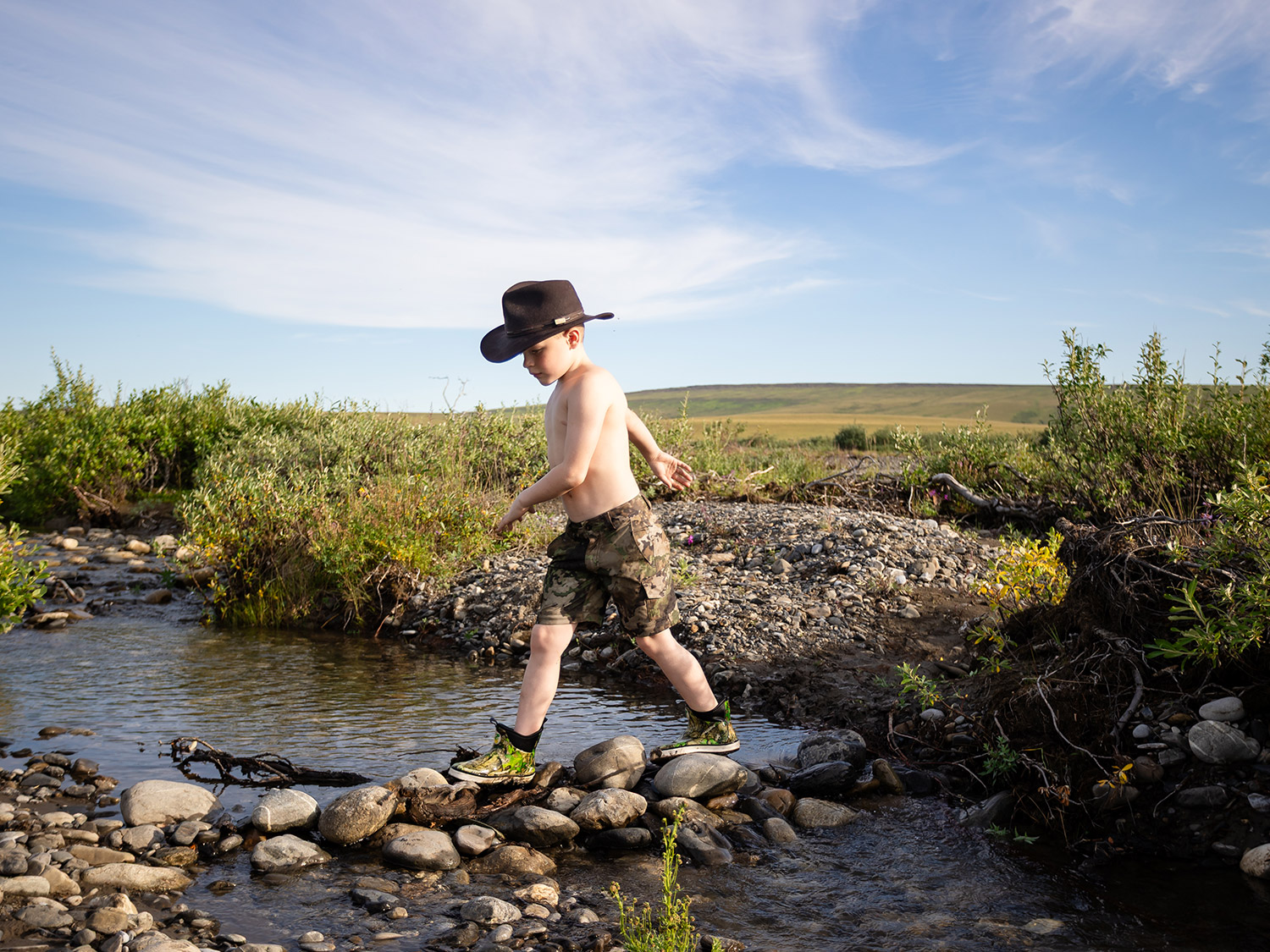
Bridges Over Cold Water
At the river’s edge, Knox turned washed-out channels into adventure — engineering makeshift bridges and charging through icy torrents without hesitation.
BLUEBERRIES IN THE MIDNIGHT SUN
After an hour, mosquitoes and icy water pushed us back up the bank. Sue was done with her paperwork and radio calls. “Ready to find some blueberries?” she asked. Knox whooped, and that was that.
We piled into the side-by-side and rattled out across the tundra, hunting for blueberries. The first patches were meager — a berry here, a berry there. But Sue, ever the optimist, knew the land better than anyone. She steered us toward one of her secret spots, and sure enough, the ground blushed with blue.
Knox dropped to his knees, pail in hand, and the hunt was on. The berries were tiny, no bigger than a pea, but bursting with flavor. Our fingers turned purple, our laughter carried across the open plain. Every time Knox found a cluster, he’d call out like he’d struck gold. Sue knelt beside him, showing which berries were ripe and which to leave.


That’s when Knox discovered the underground tunnels. He stomped on a hollow spot, and the tundra made a dull drumbeat beneath his boots. He jumped again, laughing at the sound. Sue explained that these were ground squirrel burrows, and that bears did the same thing — listening for the hollow thump that betrayed a hidden snack. Knox’s grin stretched wide. He hadn’t just been playing; he’d been doing what bears do.
For me, it was more than berry picking. It was watching Knox discover the world in real time — seeing curiosity, resilience, and wonder grow in him, up close. Biologists call it biophilia — the instinct to connect with nature and with other forms of life. That’s exactly what I witnessed: Knox on his knees in the moss, hands stained blue, finding his place in the story of the tundra.

Jewels of the Tundra
Small and easily missed, Arctic blueberries thrive close to the ground, offering bursts of flavor to anyone willing to kneel and search.

A Feast on the Ground
With hands stained purple and cheeks full, Knox stretched out in the grass, savoring his harvest under the warmth of the midnight sun.
By the time we headed back, the side-by-side rattled with buckets of berries, our boots were soggy, and our hearts were full. Camp greeted us with the smell of mosquito coils — the signature scent of Kavik — and the steady rush of the river beyond the berm. Knox was already planning breakfast, telling anyone who would listen — his audience of Sue, me, and a couple of curious foxes — that tomorrow he’d be eating Sue’s world-famous blueberry pancakes. He’d been talking about those since before we left our Boling, Texas, pastures.
That night, while the midnight sun still glowed on the horizon, Sue invited Knox into the greenhouse. She showed him strawberry blite — a rare little plant she was coaxing along, perhaps as a backup in case our blueberry picking had been a bust. Thoughtful as always, Sue had made sure there would be berries one way or another. Knox tasted a few, marveling at how something so small and bright could thrive in such a harsh place.

A Bucket of Treasure
Knox marched through the berry fields, pail in hand, treating every handful of blueberries like nuggets of gold.

Worn Out by Wonder
After a long day of berry picking, bridges, and play, Knox fell asleep in the simple cabin bunk, hands faintly stained blue.
Later, back in our cubby, he barely made it through a few minutes of Kendall Gray videos before falling asleep, hands still faintly stained blue, while the day’s harvest rested safely in the fridge.
The tundra had worn him out, but it had given us a gift too: a day of discovery, connection, and joy that no itinerary could have planned better. Tomorrow, the berries would turn into pancakes. Tonight, they were simply proof that wonder still lives in the smallest things — if you’re willing to kneel down and pick it.
DAY 3 – DUMBO IN THE NORTH
The morning of Day 3 began like all good Kavik mornings do — with the smell of mosquito coils curling through the dining hall, coffee steaming in mismatched mugs, and Knox bouncing in his seat, eager for what was coming.


Breakfast was the main event. Sue had promised her world-famous blueberry pancakes, and Knox had been counting the hours. He grinned when the plate finally hit the table: pancakes studded with the berries we’d picked, bacon cut in half so it wouldn’t curl, and a jar of Sunny D nearby — a Kavik classic. He ate like it was his birthday, declaring once again that Sue’s cooking belonged in some Arctic Michelin guide.
Sue said the day would be special. The C-46 — nicknamed Dumbo — was coming. For a place hundreds of miles from the nearest paved road, Kavik is surprisingly busy. Planes come and go daily, refueling, dropping supplies, carrying scientists, hunters, or bush pilots further north. It’s a gas station, a crossroads, and a home base all in one. But Dumbo was different. This was the big one.
We heard it before we saw it. Sue caught the sound first, tilting her head toward the horizon. Minutes later, the rest of us heard it too — a low, steady growl, like thunder rolling closer. Then it appeared, silver and massive, lumbering through the sky like a relic of another era. Dumbo wasn’t sleek or modern; it was a World War II-era beast, scarred by decades of service, still shouldering the task of carrying fuel to the most remote corners of Alaska.


The ground shook as it passed overhead and lined up for landing. I thought back to yesterday’s ride in with Gordon’s county-fair Gravitron banking and silently thanked Catherine’s instincts to skip it. Knox whooped as Dumbo’s wheels kissed the gravel, spraying dust in every direction.
On the ground, it was a ballet of logistics. Pilots climbed down, unrolled massive hoses, and within minutes, the big tanks were being topped off. Sue moved through it like clockwork, waving, checking gauges, swapping stories with the crew. Knox and I stood back, front-row spectators at a show we’d never seen before.


Then came the best part: we were invited inside. Knox climbed into the cockpit, wide-eyed, peppering Greta the pilot with every question an eight-year-old brain could produce. “How fast does it go? Can you do flips? What happens if it runs out of gas?” She answered each one with a grin. For Knox, it was less about airplanes and more about possibility.

Climbing Into History
With determined steps, Knox climbed Dumbo’s ladder, eager to explore the cockpit of the massive plane.

A Pilot for a Moment
Seated at Dumbo’s controls, Knox peppered Greta the pilot with questions, his imagination running faster than the engines ever could.
When the fueling was finished, Dumbo taxied back down the gravel strip, engines roaring, until the tundra swallowed the sound again. Almost immediately, smaller planes began to appear — one after another, refueling, trading goods, even one with skis still attached, flown by a glaciologist.
That scientist took time to talk with Knox about meltwater. He explained how glacial runoff carries silt to the rivers, feeding invertebrates, feeding fish, feeding bears, feeding people. One stream of icy water powering an entire food chain. Knox soaked it in, asking how far the water could travel, how long it took. He was seeing connections between glaciers, rivers, salmon, and even us — what scientists call a web.
By the time the airstrip quieted again, the adrenaline had worn off. Knox and I drifted back to the dining hall, settling into the easy rhythm of Kavik — which often means snacks. Popcorn for me, Sunny D for him, both of us staring out the windows as the tundra went still again.
That’s when Sue walked in, grinning, holding a glass mason jar filled with what looked like ash. She set it on the table. “Taste it,” she said. Inside was her own blend: Arctic Ocean sea salt mixed with homemade activated charcoal. Knox sprinkled it on everything within reach, convinced he’d found Kavik’s secret treasure.


Later, standing outside camp with Sue, we watched the horizon blur. Above the flat tundra, ghostly shapes floated in the sky — icebergs, she explained, though we were miles from the Arctic Ocean. “It’s a Fata Morgana,” Sue said, pointing. “A mirage. The air layers bend light, and the Earth’s curve does the rest. That’s why it looks like the sea is in the clouds.”
Knox squinted, tilting his head. “So… those are real icebergs, just not where I think they are?”
“Exactly,” Sue nodded. “Your eyes see them lifted up, but they’re actually sitting in the water far beyond where you can normally see.”
Knox jumped up and down, as if testing whether the illusion would wobble. “It’s like a magic trick,” he said.
And it was. The Arctic Ocean reminding us how close it really was. In a place already surreal, seeing “boats in the clouds” turned science into wonder — the kind of lesson no classroom could hold.
The evening slowed even more. After dinner — Knox had asked Sue for pizza, of course — I stretched out in our little cubby, the faint smell of mosquito coils still clinging to my clothes, and opened an advance copy of Sue’s book, North of Ordinary. Reading her words in the place she wrote about felt almost otherworldly, like hearing a story whispered by the tundra itself.


Outside, the sun never dipped. Inside, Knox was already asleep, iPad still playing Kendall Gray. And I thought: this is what Kavik does best. It gives you adrenaline one moment, stillness the next, and memories in every direction.
DAY 4 – LAST LIGHT, LAST BERRIES
Our final morning in Kavik started like all the others: pancakes, bacon cut in half, and the constant buzz of mosquitoes. Knox wolfed down breakfast and tugged at me—he wanted one more round at the river before the plane came.
We grabbed the bear spray and went. The river had become his playground: building, splashing, testing how far he could push into the icy water. But this time, something felt different. Seagulls and ravens wheeled low over the water, gathering in numbers we hadn’t seen before. Knox remembered Sue’s lesson from our first trip: birds follow the predators.
“Dad,” he said quietly, “does this mean there’s something out here?”
Better safe than sorry. We packed up and quickly walked up the hill to camp.
Not long after, the buzz of a small plane grew louder until a bright yellow Cub skimmed down the gravel strip. Out stepped Tori and her husband, smiles as big as the tundra sky. Sue introduced us as family—and just like that, we had new friends. We chatted for a moment, and when Knox announced he was going fishing, they grinned and wished him luck before heading off to complete their preflight checklist and a quick stop at the outhouse.

Greetings on the Runway
On the gravel runway, strangers quickly became friends — the Kavik way.

Steady Steps at the River
Sue leads Knox across the rocky shallows, steady and watchful as he tests the edge of Arctic waters.

Touchdown on the Tundra
A bright yellow Cub plane brings new friends and a reminder of how small aircraft keep Kavik connected to the wider world.
Sue, ever attuned to Knox, grabbed a rifle and said, “Let’s give the river a try.” Anything for him.
So the three of us went down to the water. Knox cast his little Toy Story pole a few times, but his attention quickly drifted back to what he loved best: building. Piles of silt became forts, driftwood turned into dams. We were close to the deeper, faster water now, and every time he edged near the current, my heart skipped. One slip and it was a straight ride to the Arctic.
From the river, we heard the plane’s engine fire. We looked up just as Tori lifted off, circled wide, and then banked low over us. The wings rocked side to side in a wave, sunlight flashing on the yellow paint. Knox waved back, grinning ear to ear, his fishing line forgotten.
We returned to camp skunked but happy. The truth is, it didn’t matter if Knox caught a fish. He’d fished with Sue, and that was the victory.


Back at camp, word came through: the charter was delayed. Extra fuel barrels needed to be loaded before they could leave Fairbanks. Knox cheered. More time in Kavik. Sue smiled and said, “Let’s pick a few more blueberries—maybe you can bring some back for your mom.”
Out at the end of the runway, tundra glowing gold, Knox crouched to gather berries. That’s when Sue bent down, picked up a bone, and scraped the marrow with her fingernail. She sniffed, then looked at us seriously. “Fresh. This was that lone caribou.”

Tundra’s Treasure
Small but powerful, these Arctic blueberries carried the taste of Kavik home for Catherine.

Lessons in Every Step
Side by side with Sue, Knox learns to read the tundra’s quiet language — from tracks to berries to bones.
The birds. The missing tracks. It all made sense. Somewhere just beyond sight, a predator had claimed its meal. The tundra had shifted while we weren’t looking.
We tucked our berries in the fridge for Catherine and headed back to wait. The sky held its strange, endless light, and Kavik did what it always does—taught us to pay attention.
LEAVING KAVIK
As the blueberry buckets for Catherine chilled in the fridge, the charter finally crackled over the radio: inbound. We knew our time was almost up.
When the plane appeared, it carried not just groceries and freight but rows of fuel barrels. The unloading was something to see: drums rolled straight out of the cargo door, bouncing onto stacked tires before thudding into the dirt. It looked reckless—like one wrong move could set the tundra ablaze—but Sue directed the ballet with her usual calm. For her, it was routine; for us, it was a reminder of how fragile and fierce survival is in this place.


Knox didn’t notice the danger—his attention was on Bill. Sue had decided her old poodle needed a trim and would fly back with us. Bill strutted around camp with one of his “babies” in his mouth, kept close on a leash or tucked under Sue’s eye. In Kavik, even a toy poodle can look like a snack to the wrong set of teeth.

Where It All Began
A reminder from Knox’s first Kavik trip — the seed of an Arctic love that grew with every return.

A Final Goodbye
Our last moments at Kavik weren’t just farewells — they were gratitude, stitched into memories we’d carry home.
When it was time to board, Knox scooped Bill into his arms like precious cargo. The little dog climbed the steps with us, curling against Knox’s leg once we found our seats. Watching them, I knew this bond would last longer than the flight. Back in Texas, Knox would carry Kavik home in the best way an eight-year-old could—by naming his new heifer Bill Jr. after his Arctic companion.


As the engines roared and the plane lifted, Kavik shrank to a smudge against the tundra, the Brooks Range dim in the distance. It wasn’t just geography we were leaving. It was Sue’s laugh, the mosquito coils, the smell of river silt and pancakes, the odd magic of a camp that had become family.
From the window, the endless North Slope stretched out one last time, reminding us of something we’d already learned: leaving Kavik is never really leaving. It follows you home, stitched into the way you see the world.
BACK TO FAIRBANKS
The moment we lifted off, the Brooks Range rose almost immediately — jagged, immense, stretching on and on like a spine across the horizon. From up here, it seemed endless. Snow still clung to the highest ridges, rivers cut silver threads below, and then, gradually, the peaks gave way to forests, the Yukon, and finally the edges of Fairbanks.
The hum of the engines was steady, but my mind wandered. Leaving Kavik always stirs something in me — a tug I can’t quite name. Part of it is the sense of unfinished business, of questions that only more time in the tundra could answer. Part of it is knowing how fragile opportunities like this are. Will we be able to return? Will Knox be this excited, this curious, this wide-eyed the next time? The North has a way of making you measure not just distance, but time.

I watched Knox scratch Bill’s ears, his face pressed against the little dog’s curls, and thought about the lessons hidden in Kavik. To live in the moment. To pay attention. To find joy in building bridges of willow branches or filling a pail with blueberries. Catherine and I have joked that school isn’t where Knox learns best — but up here, that thought pressed a little harder. Maybe the real education is in listening to rivers, watching birds, and asking questions of the land itself.
The plane dipped, lined up with Fairbanks’ runway. Knox’s head was already swiveling, looking for his mom. And soon enough, there she was. Catherine stood outside Pike’s, waiting with the kind of smile that only comes after days of quiet, river walks, and reading by the water. She had pizzas ready for Knox — because she knows pizza is his all-time favorite food, whether in Texas or Alaska.

The One We Missed
While we flew south, a polar bear lingered at Kavik — a silent reminder of the wild just beyond our reach.

Pizza at Pike’s
Knox’s favorite food was waiting in Fairbanks, the perfect comfort after Kavik’s lessons in survival.
We hugged, swapped stories, and laughed over the fact that while she had enjoyed the peaceful comforts of Pike’s, we had been banking through Gravitron turns, wrangling barrels of jet fuel, and stomping through blueberry patches. Her adventure had been no less real — it just came with fewer mosquitoes.
That night, as we settled back into Pike’s with Catherine by our side, the Kavik stories spilled out faster than we could tell them. Knox reenacted the blueberry hunt, Sue’s pancakes, and Dumbo’s thunderous landing. Catherine listened, smiling, shaking her head, and laughing in the right places, the way she always does.
And then, as the room finally quieted, my phone buzzed with a message from Sue: “You won’t believe it. A polar bear at camp.”
It explained the gulls and ravens Knox and I had seen circling the river the day before, the unease that tugged at us when no tracks showed in the silt. Sue said the bear’s rear end was stained blue from all the berries it had been gorging on. And the fresh caribou bone she’d scraped the marrow from? That had been its kill.
Sue told us that when a polar bear is close, everything in camp shifts — doors slam shut, movements tighten, the rules change instantly. Unlike a grizzly, a polar bear doesn’t just wander through. They linger. They test. They wait.
Knox listened wide-eyed, then nodded solemnly. “That’s why we came back when we saw the birds,” he said. He was right. In Kavik, instincts and wisdom — Sue’s, his own growing — aren’t optional. They’re survival.
That polar bear, heavy and white against the tundra, never crossed our path. But knowing it had been just beyond our reach made the leaving sharper, and the lessons linger longer.
Kavik was behind us now, but the glow of it remained. Tomorrow, Denali would call. But tonight, reunion was enough.
Stay tuned for details on Part 2 of our Alaskan Adventure!
Stay Up To Date with V8!
Get ranch updates, sale news, and stories from behind the gates — straight to your inbox.


As I read thru this story Jenna and I were patiently waiting to here as they say “ the rest of the story” that one afternoon that Jen and I ate with the Williams family as Catherine spoke at the dinner table about this up coming trip, she spoke as a true Rebel how this time she was gonna do it. Knox told her over and over “ mom don’t be sacred we will be fine as long as we are together”. Gotta love that family!❤️