

Decoding Brahman Cattle Colors
Understanding Brahman cattle colors isn’t as straightforward as one might imagine. While other cattle breeds are clearly defined by their pigmentation (Charolais are white; Angus are black; Herefords are red and white), Brahman cattle colors comprise a much broader spectrum. So what color are Brahman cows and bulls? Well,it depends on who you ask, when you ask, and why you’re asking.
Official Classifications for Brahman Cattle Colors
All American Brahmans are registered as one of two official color classifications within their herd book: Grey Brahman and Red Brahman. Breeders must designate a calf’s coat color at the time of registration.
Despite this two-color classification system, visually Brahman cattle range in color from white to red to light grey to dark grey to blue to black. Just as the hair of towheaded children often darkens with age, Brahman cattle colors can change over time. For example, some Grey Brahmans are born with a “red” tinge coat that gradually changes to grey (or “blue”) as the calf matures from birth to weaning.
And, to make it even more challenging, Brahmans not only change color with age, Brahman cattle colors can also change according to the seasons. For example, here is Miss V8 222/8 with a darker coat in the winter and a lighter coat in the summer.
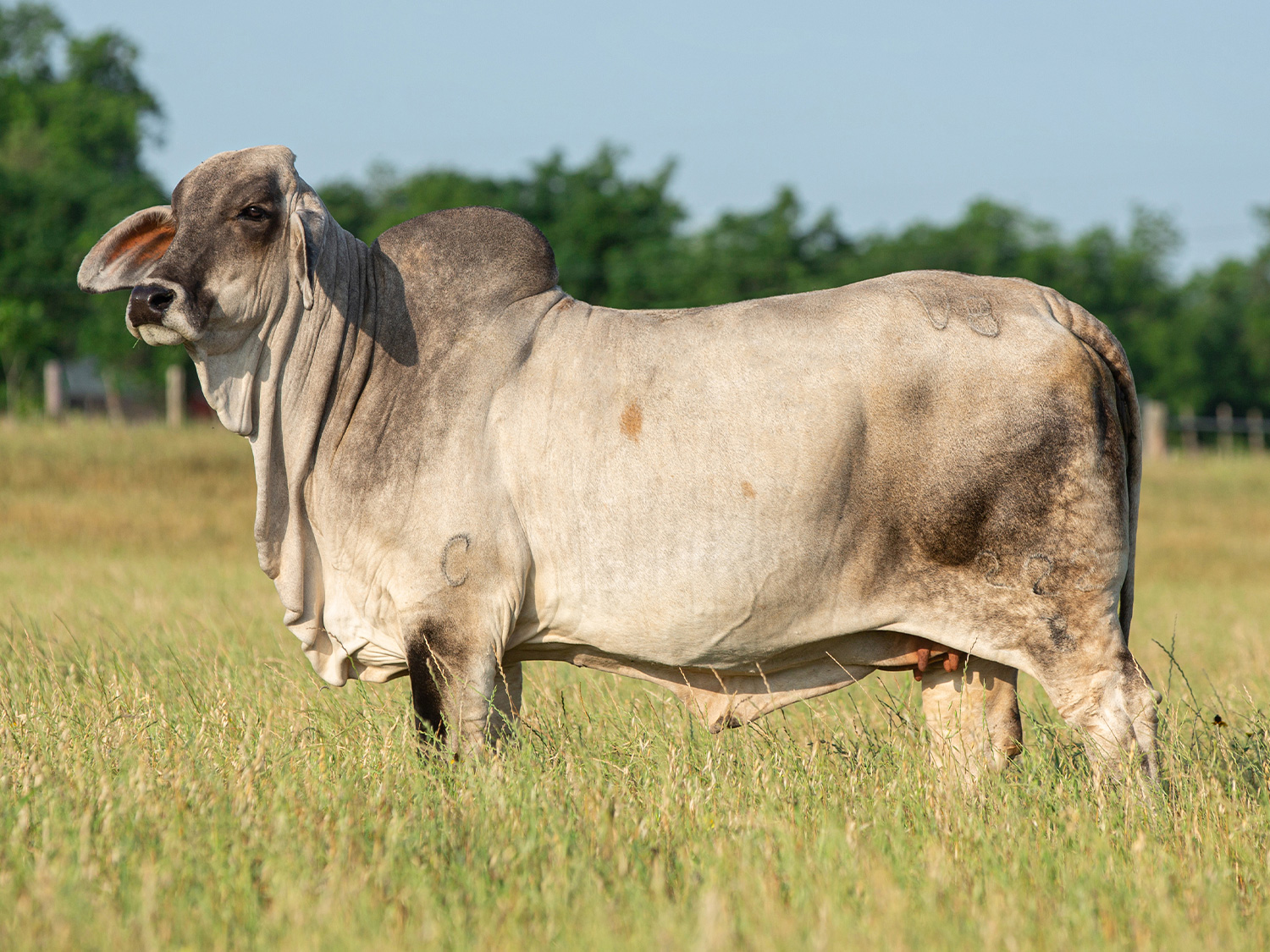
Miss V8 222/8
Winter Coat
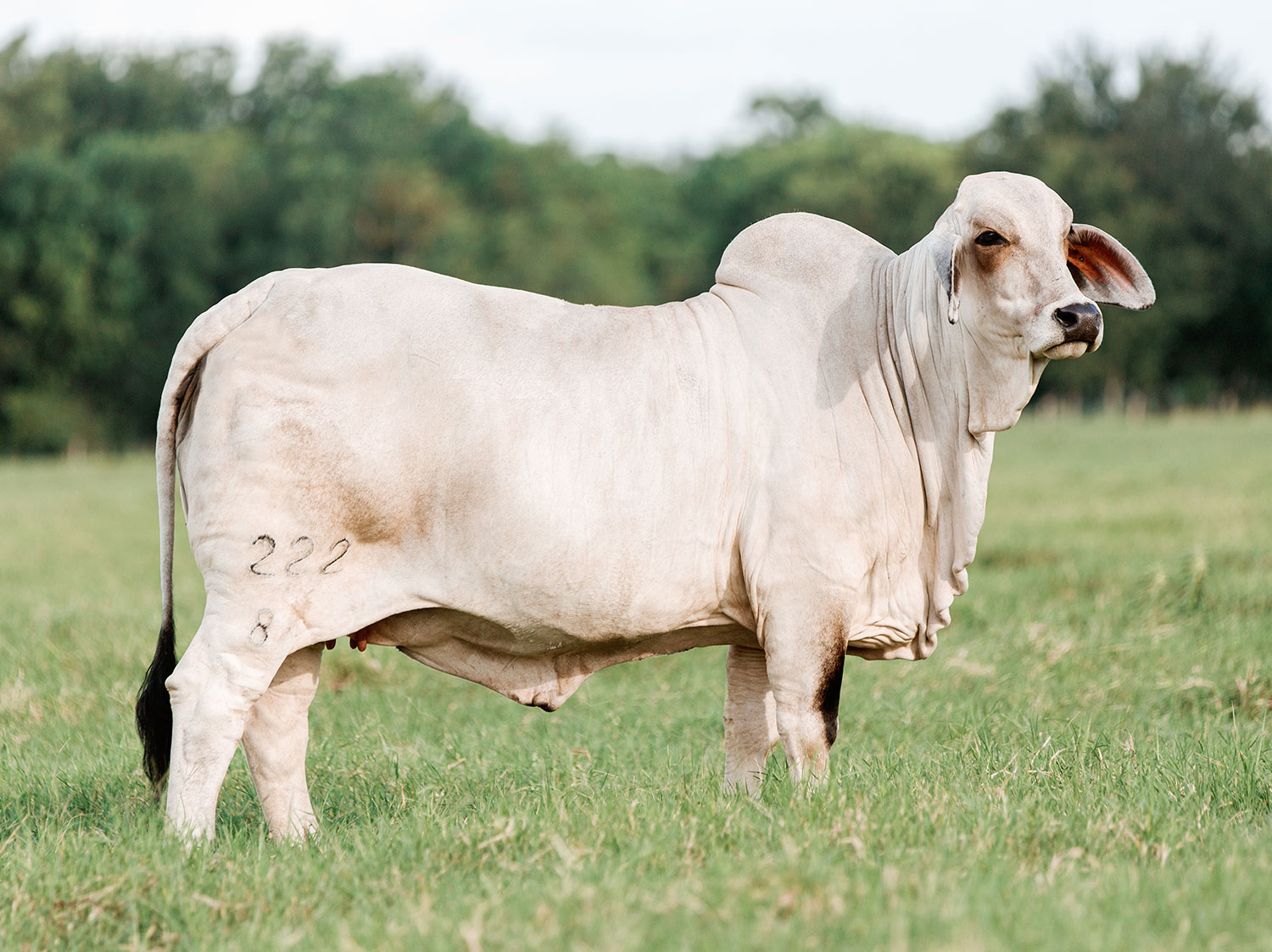
Miss V8 222/8
Summer Coat
You may not believe this, but there have been times we thought we “misplaced” a cow before, simply because she changed colors!
Which Color is the Best for Brahman Cattle?
The American Brahman Breeders Association’s Standard of Excellence lists the ideal Brahman colors as “grey or red of varying shades of predominance.” It also notes that brindle, gruella, and true white (albino) are disqualifications. Muzzle, hooves, and switch should be black, horns dark. Some U.S.-based cattle shows group all Brahmans in the same division; others offer a “split show” where grey and red cattle compete in separate divisions.
Most color classification is conducted by visual appraisal, but if a calf will be shown in a “red” division, the breeder must be able to prove that a percentage of its pedigree traces back to red bloodlines. This prevents Grey Brahmans with red coats from showing in the wrong division.
Beyond the gray and red classifications listed in ABBA’s Standard of Excellence, it really comes down to breeder preference. Some breeders place a high value on color and color uniformity – certain breeders prefer animals with white coats and black tips; others prefer animals with all-black coats.
At V8 Ranch, we don’t focus on color preference; we focus on quality. In fact, we’ve been able to buy some great cattle from other ranchers who were selling them because they didn’t conform to their color preferences. However, we have noticed, based on customer purchases, that our red-tinged and dark-pigmented cattle are in high demand. This may be because many consider red-tinged cattle to be a signature color for V8 Ranch. The red-tinge, which we call V8 Rose Red, comes from Miss V8 495/5, the matriarch of one of our most famous cow families, The Rose Family.
It’s also worth noting that some breeders focus entirely on color classification in promoting their Brahman cattle for sale. While this “Grey is best” sales technique certainly sways some buyers, savvy ranchers understand that true quality is more than skin deep (or rather, hide deep). When you buy Brahman cattle or Brahman bull semen from V8 Ranch, not only do you get high-quality genetics, but we also ensure you have adequate education to feel confident you’re making the most of your investment.
Brahman Cattle Coat Color Versus Pigmentation
While we are open to different coat colors, we do want all our animals to have plenty of pigment. For us, a black nose and tail are a must. You’ll also see V8 Brahman cattle that have “black tips”. These cattle look like someone took a permanent marker and drew a line around their ears and reproductive organs.
Black-tipped Brahman cattle also have shiny black noses in contrast to the duller black nose on other animals. Animals without black tips may not have shiny noses, but they do usually have a pink tip to their ears. Again, these differences generally all boil down to breeder preferences.
There is, however, one interesting thing to note when breeding black-tipped animals; their offspring can easily be bred either red or grey. In other words, when a black-tipped Brahman is bred to a gray animal, it produces a grey calf; when bred to a red animal, it produces a red calf. You can also breed a dark pigmented Grey bull to a Red cow and get red offspring that are 50/50 by pedigree!
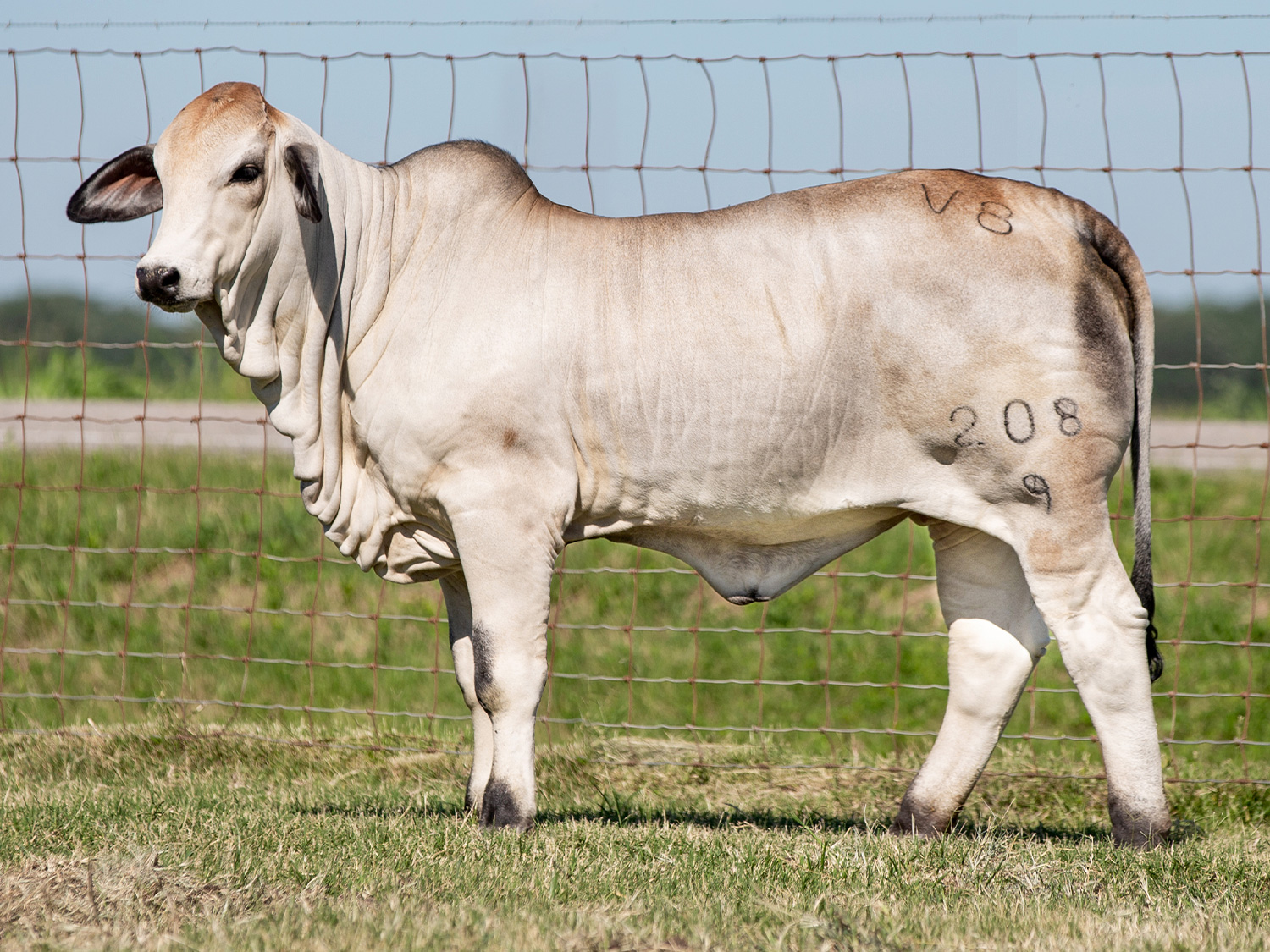
Miss V8 208/9
Made for Magic sale heifer
Which Colors Are Classified as Grey Brahman Cattle?
A majority of the Brahman breed is light to medium grey. Grey Brahmans can also appear to be solid white, solid grey, blue (meaning born red, but having turned dark grey with lighter ears and tips), solid black, or darkly pigmented with black-tipped ears and body points. Grey Brahmans also include animals that might be lighter in color in the middle with grey or darker black pigment along the front shoulders and hindquarters. There are also Grey Brahmans that present a snowflake pattern. Finally, it is possible to have red-tinged or even predominantly red cattle who classify as Grey Brahman, provided their pedigree is 100% grey.
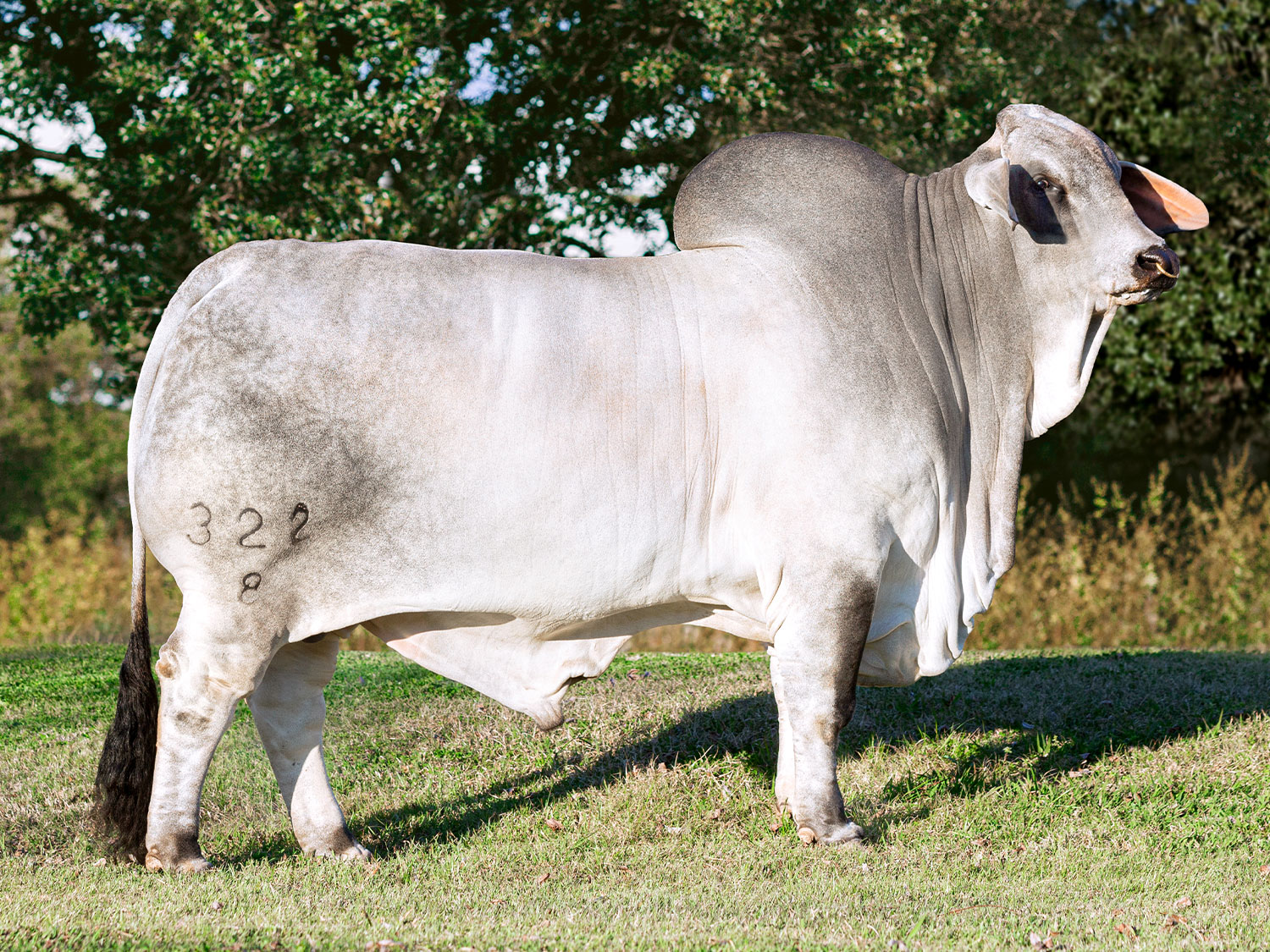
+Mr. V8 322/8
Snowflake Pattern
When Red Brahman Actually Means Grey
Take a look at this Brahman Journal color chart, and you’ll notice considerable variation in the colors within both the Red and Grey Brahman categories. That’s because the biggest difference between the Grey Brahman and Red Brahman classifications isn’t really color. The two groups have distinct physical differences that set them apart.
Four breeds of Indian cattle were brought to the United States and used in the development of the American Brahman as we know it today. They were the Guzerat, the Nelore, the Gyr, and to a lesser extent, the Krishna Valley strain. Grey Brahmans display characteristics of the Guzerat bloodlines. This can be attributed, in large part, to J.D. Hudgins’ early influence in the development of the breed. Manso, the foundation sire of the breed, was a Grey Brahman bull as were many of the early bulls J.D. Hudgins imported from Brazil in the early 1920s.
For an example of the differences in physical characteristics between Grey and Red Brahmans, compare this “red” Grey Brahman bull with this Red Brahman bull.
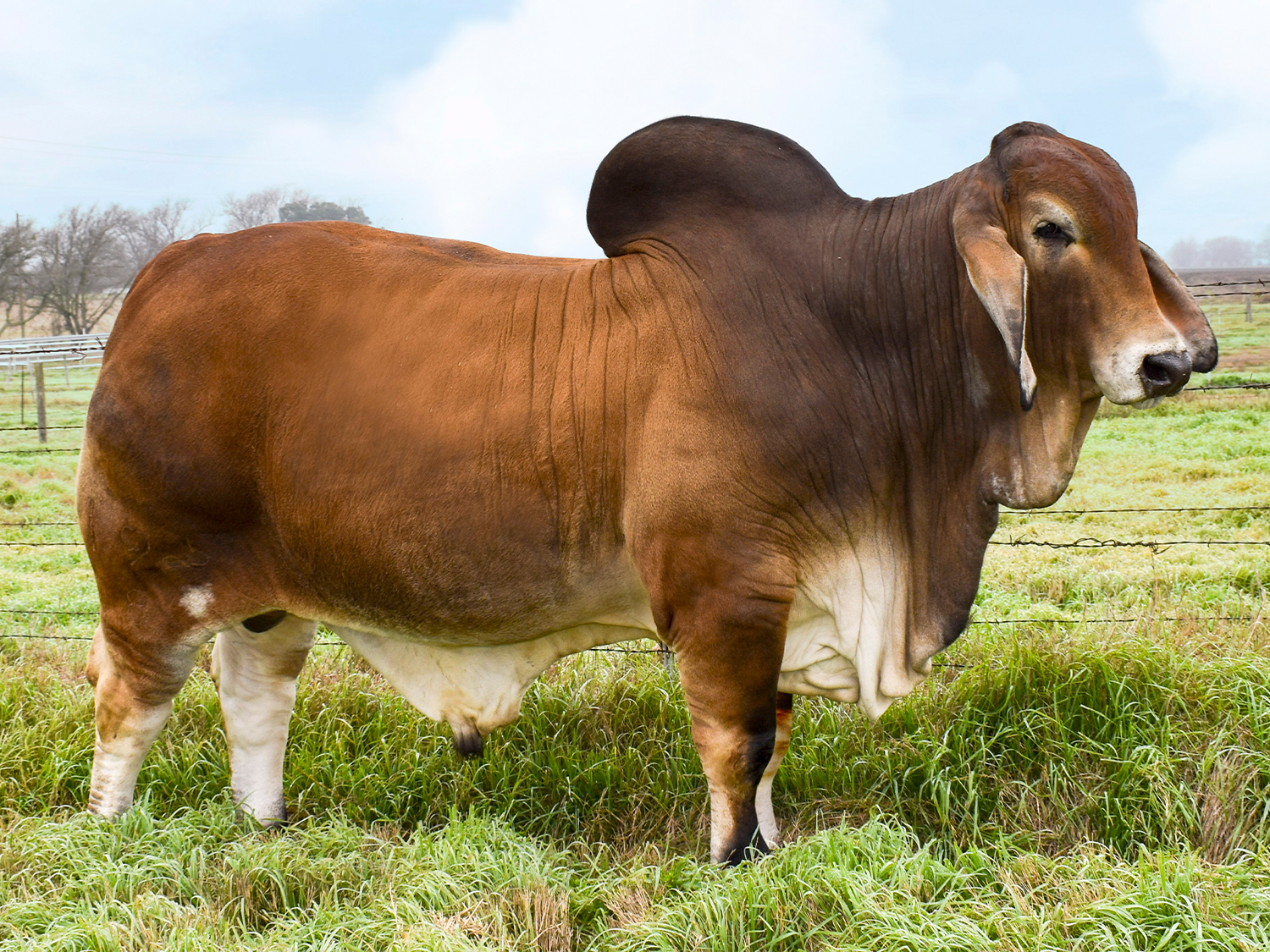
+Mr. V8 195/8 – “Red Man”
American Grey Brahman Bull with Red coloration
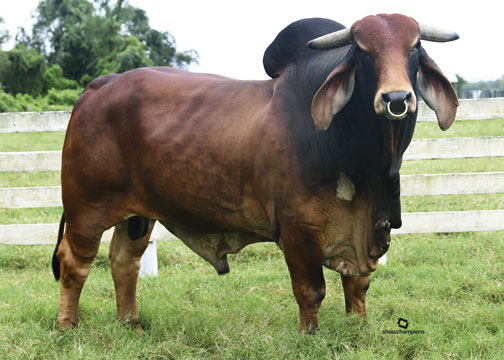
HK x-Ray 825/1
American Red Brahman Bull with Traditional Coloration
Bull Owned by HK Ranch
Both of these Brahman bulls have long floppy ears, but when you study their ear shape closer, Red Brahman Cattle generally have a longer ear that has a slight curl to it. Also, while both Grey and Red Brahmans can be called “cows with humps” Red Brahman bulls will have a darker hump and maintain their red color along their brisket, underline, and lower legs.
Red Brahman Coats and Red Pedigree
It wasn’t until the 1940’s that the Red Brahman breed was recognized by the American Brahman Breeders Association. Whereas Grey Brahmans were heavily influenced by the Guzerat breed, Red Brahmans descend from the Gyr breed which were primarily imported from Mexico. Like the Grey Brahmans, Red Brahmans include a full range of shades from light red to an orangish-red tinge to a rich, solid cherry red, to a highly favorable deep red that is so dark it appears to be almost purple or black. You will also sometimes see speckled Red Brahmans with white spots along their necks. Red Brahman coat colors may vary considerably, but nearly all Red Brahmans will have a black skin pigment base, yielding black-tipped ears and black vulva and dark pigmentation on the testicals.
American Brahman Cattle Colors Promote Inclusivity
So, what’s the takeaway when it comes to this rainbow of Brahman cattle colors? There’s room for Brahmans of every color on the official Brahman registry and show circuit. Breeders have the freedom to express their preferences and uniquely distinct Brahman animals like Rose and Mr. V8 380/6 enjoy notoriety while adding interest to the breed.
As one of the leading Brahman cattle breeders in the world, we believe that quality is more than just color. When you partner with us (whether by buying one of our Brahman cattle for sale or investing in semen on our Brahman Herd Sires), you can feel confident that every V8-branded animal carries a promise – a promise of superior quality, pedigree, and an unwavering commitment to authenticity.
When you choose V8, we make you part of our family. So we ensure you have all the education and support you need to thrive as part of the American Brahman tradition. We’re backed by over 75 years of quality bloodlines, legacy, and transparency, so you never feel like you’re on your own or have to keep buying your way to a successful program.
Want to learn more about the tapestry of Brahman colors within the Grey and Red Brahman breeds? Contact us at V8 Ranch.



0 Comments